Sales flow
Deals opened, priced, approved and confirmed inside the platform, with the rules of who may agree what built in, so a promise made in the field is already a record in the company.
Agricultural supply · Ukraine
An agricultural supply company in Ukraine — selling tires and manufacturing dual wheels for tractors — ran on a standard company-management platform that covered accounting well and the rest of the business badly. The tires it sold aged on the shelf, the wheels it made were costed after the fact, the representatives in the field worked outside the system, and the owners learned what had happened from reports assembled afterwards. We customised the platform until it ran the company, not just its books.
The situation
The company supplied agricultural businesses. Tires were its largest and most awkward product line, and beside the warehouse it ran a workshop making dual wheels for tractors — a product assembled to order from rims, spacers and hardware, and from the tires in stock. A standard company-management platform was already in place, and for accounting it was fine: invoices, payments and tax reporting all went through it. But a standard configuration is built for an average company, and this one was not average. Sales moved through representatives working directly with farms. Stock lived in a large warehouse where a tire is heavy, bulky, and quietly loses value the longer it sits.
So the real workflow lived next to the platform. Representatives kept their own lists of customers, prices and promises. Warehouse workers picked whichever tire was nearest, which meant the newest stock left first and the oldest stayed until it was too old to sell at full price. The workshop built wheels from parts and tires drawn informally from the same stock, so the cost of a finished wheel was worked out afterwards, if at all. Finance reconciled what the representatives had agreed with what the warehouse had shipped, after the fact, by hand.
The owners saw all of this through reports built at month end. They were accurate and late. A question like which representative is selling, which stock is ageing, and how much cash is tied up in tires nobody has moved this season could be answered, but only by someone spending a day on it.
The actual problem
A standard configuration runs a standard company. The work is in the difference.
Starting point
The platform was the system of record for accounting and nothing else. Sales, warehouse and management each kept the part of the picture they needed, in the tool that was nearest to hand, and the platform found out later — if at all.
How it started
We followed a single order from the moment a representative agreed it with a farm to the moment the tires left the warehouse and the money arrived. Every place the order changed hands was a place the standard configuration lost track of it, and those became the list of what to build.
How a deal is opened, priced, approved and confirmed, and what a representative is allowed to decide alone. Written down as a flow the platform could enforce rather than a habit each person had.
Where each tire type is stored, how a worker finds one, and why the oldest stock was being skipped. The answer was simple: nothing told the worker which tire to take.
Which parts and which tires go into a dual-wheel assembly, where they come from, and how the finished wheel gets back into stock as a product with a cost of its own.
Where finance was reconciling by hand, and which of those reconciliations disappear once sales and warehouse post into the same ledger as accounting.
With the owners: the handful of figures they were asking for every month, defined once so they could be shown live instead of assembled.
Which department moves first, and what has to be true before the next one can. Sales and the warehouse went first because that was where the money was leaking; the workshop and the dashboards followed on top of them.
Architecture
The platform's accounting and financial core was sound, and replacing it would have thrown away years of correct records. So the core stayed. Everything the company actually does — selling, storing, picking, shipping, deciding — was built as customisation on top of it, posting into the same records the accountants already trusted. One sale creates the order, reserves the stock, drives the pick, produces the shipment and the invoice, and lands in finance without being typed twice.
What moved in
The engagement was not one feature. It was the whole company, moved onto one platform department by department, so that the same record flows from a representative's first conversation to the owners' dashboard.
Deals opened, priced, approved and confirmed inside the platform, with the rules of who may agree what built in, so a promise made in the field is already a record in the company.
Each company representative works in the system with their own access — their customers, their deals, their stock availability — instead of a private list that the office finds out about later.
Receipts, locations, reservations, picks and shipments recorded as they happen, so quantity on hand is known by place and by age, not just in total.
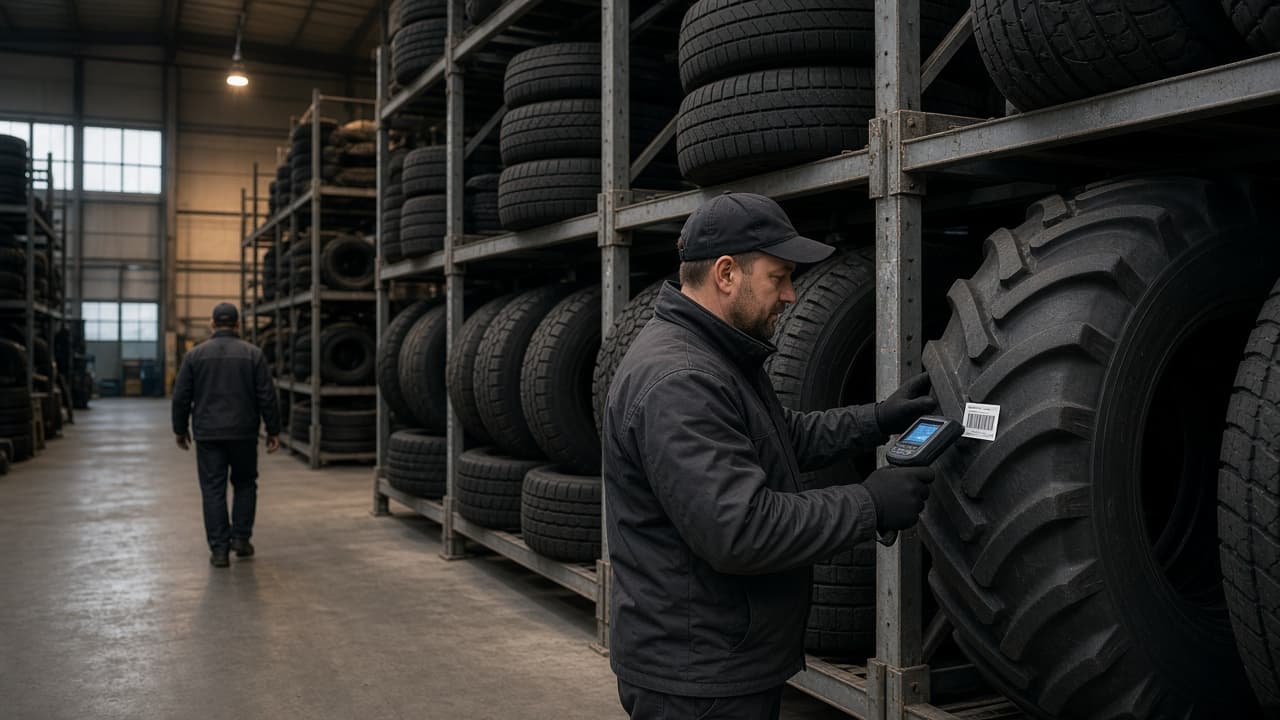
Every tire labelled and scanned on arrival, so its manufacturing date and its place in the warehouse are known from the moment it enters.
An app for warehouse workers that tells them which tire to take — the oldest matching unit, wherever it sits — so identical tires leave in the order they arrived and none of them age past their value.
Wheels for tractors built to order in the company's own workshop. Each assembly is a production order that consumes rims, spacers, hardware and the specific tires it was built on, and posts the finished wheel to stock with a cost calculated from what it actually used.
The standard core, now fed automatically by sales, warehouse and production, so the reconciliation finance used to do by hand does not exist any more.
Sales by representative, stock by age, cash tied up in inventory, and receivables — live, for the people accountable for them.
The events that matter — an order needing approval, a shipment leaving, a payment arriving — sent to the right person's phone as they happen.
The difficult part was scope, not any single piece. A standard platform resists deep change: customise it carelessly and every vendor update breaks something. Each department's needs had to be built inside the platform's own model, in a way that would survive upgrades and stay consistent with the accounting core, while the company kept selling and shipping every day. The warehouse was the sharpest case. A tire is a tire until you know its date, and then two identical tires are not equal at all — the system had to carry that distinction from the receiving dock to the worker's hand, and on into the workshop, where the same tire might become part of a dual wheel instead of a sale.
Keep the standard core as the ledger. Build every operational area as customisation that posts into it, one department at a time, starting with sales and the warehouse where the company was losing the most, then the workshop. Give each role its own surface — a representative's access, a warehouse worker's app, an owner's dashboard — all reading and writing the same records.
Scope
Working principle
A standard platform is a starting point. The company is the specification.
Questions we get asked
The questions below come up in almost every first conversation. If yours is not here, it is a good thing to open with.
Start with the operation
Every engagement starts the same way, whatever the industry: understanding how the work actually happens.
Show us how it works →